PSF (Plastic Scintillating Fiber)


PSF (Plastic Scintillating Fiber)
- High light output: Easy to ensure detection sensitivity. Easy to extract signals even at low doses and long distances.
- High dimensional accuracy: Assembled as designed and suitable for precise placement. Easy to create a reproducible detection system with minimal assembly variation.
- Small variation in quality: leads to stable detection performance. Easier to stabilize operations by reducing the time and effort required for calibration and correction.
By Application: Recommended Type
- Scintillation Fiber: This is the basic type that emits light when exposed to radiation and is used for detection.
- Wavelength Converting Fiber (WLS): Suitable for applications that convert emission wavelengths to increase light-receiving efficiency.
- Clear Fiber: Suitable for applications where transmission is desired with minimal loss of light.
Material and Composition of Plastic Scintillating Fibers
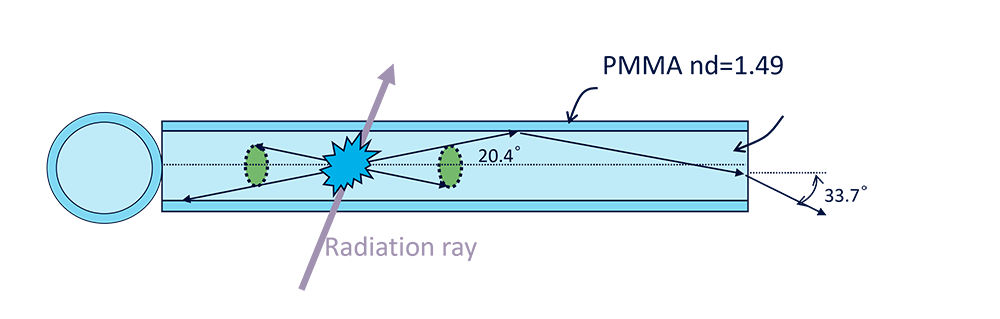
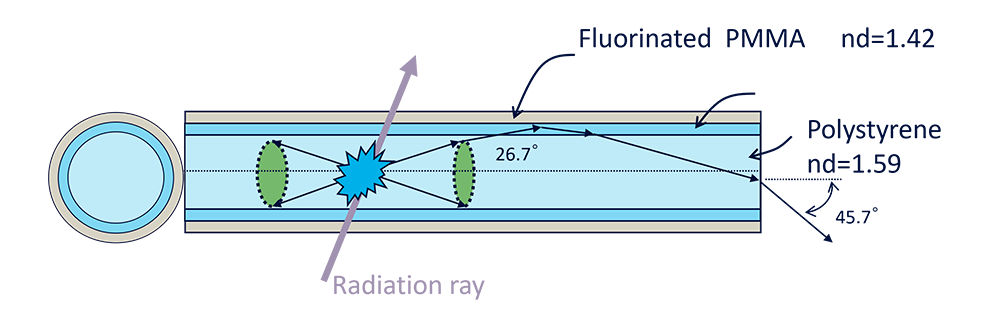
The light extraction performance of plastic scintillation fibers is highly dependent on the refractive index design of the core/cladding and the layer composition (single layer/bilayer). Multicladding increases confinement efficiency by increasing the refractive index difference, resulting in higher light collection efficiency than single cladding. The figure below shows the difference by cladding configuration and cross-sectional shape, and the table below shows reference values of refractive index and density for each material.
Round fiber
Single cladding
![image: Round fiber [Single cladding]](https://kuraray.scene7.com/is/image/kuraray/img_02-1:3-2)
Multi cladding
![image: Round fiber [Multi cladding]](https://kuraray.scene7.com/is/image/kuraray/img_03-1:3-2)
Square fiber
Single cladding
![image: Square fiber [Single cladding]](https://kuraray.scene7.com/is/image/kuraray/img_04-1:3-2)
| Material | Refractive index | Density (g/cm3 ) |
|---|---|---|
| Polystyrene (PS) | nD = 1.59 | 1.05 |
| Polymethyl Methacrylate (PMMA) | nD = 1.49 | 1.19 |
| Fluorinated Polymer (FP) | nD = 1.42 | 1.43 |
Mechanism of Light Transmission
Kuraray's "multi-clad" luminescence theoretically emits about 70% brighter than conventional single-clad luminescence.
Single cladding
Multi cladding
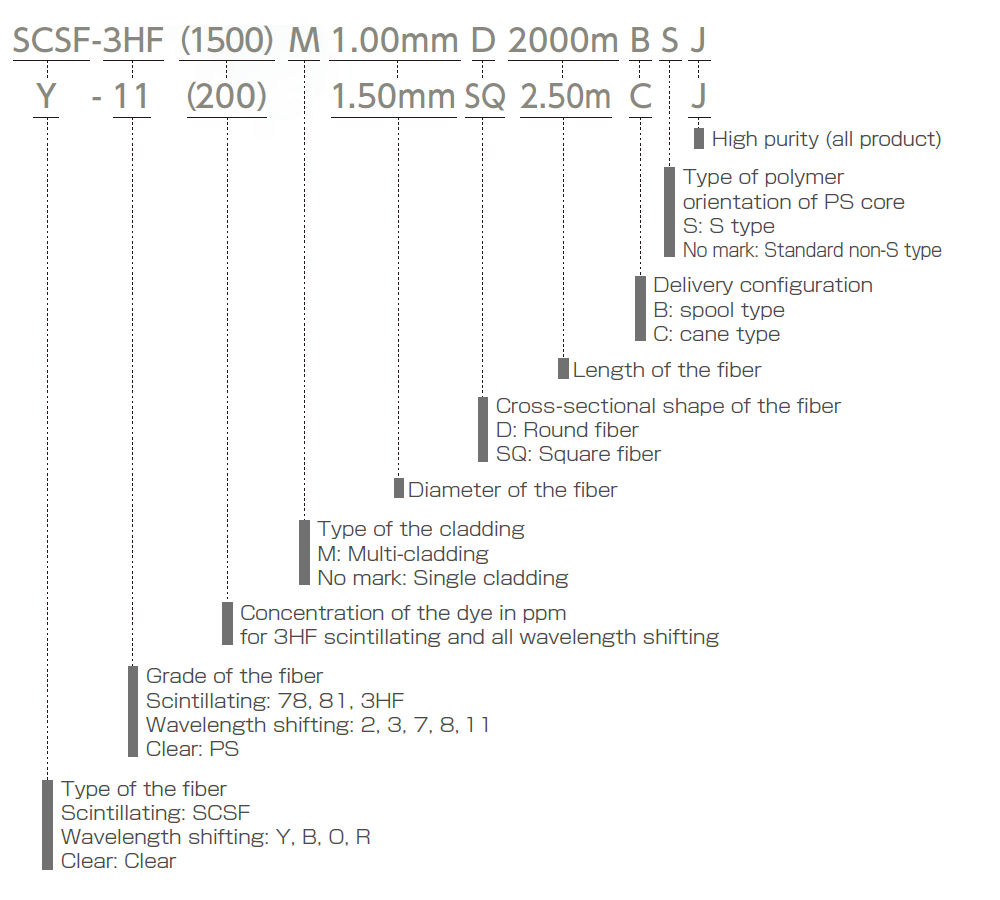
Description of Brand Name Display