
Comparison of Various Properties with Other Resins
| Material³ Item | Total light transmittance (%) ISO 13468-1 / JIS K7361-1 (%) | Deflection temperature under load ISO 75-2 / JIS K7191-2 (℃) | Rockwell hardness ISO 2039-2 / JIS K7202 (M scale) | Coefficient of Linear Expansion JIS K7197 (1/℃) |
|---|---|---|---|---|
| PARAPET™ (Methacrylic resin) | 92≦ | 86-101 | 94-102 | 6 × 10⁻⁵ |
| Polystyrene | 90 | 65-104 | 70-80 | 6-8 × 10⁻⁵ |
| AS Resin | 89 | 83-104 | 80-90 | 6-8 × 10⁻⁵ |
| Polycarbonate | 89 | 130-145 | 70-90 | 7 × 10⁻⁵ |
| MS Resin | 90 | 85-90 | 70-85 | 6-8 × 10⁻⁵ |
| Polyethylene | ― | ― | ― | 11-13 × 10-5 |
| Polypropylene | ― | ― | ― | 6-11 × 10-5 |
| Nylon 6 | ― | ― | ― | 8-13 × 10-5 |
| Carbon Steel | ― | ― | ― | 1-2 × 10⁻⁵ |
| Aluminum (Al) | ― | ― | ― | 2.4 × 10⁻⁵ |
Note: The property values shown are typical values and are not guaranteed.
Comparison of Weatherability between PARAPET™ and other resins
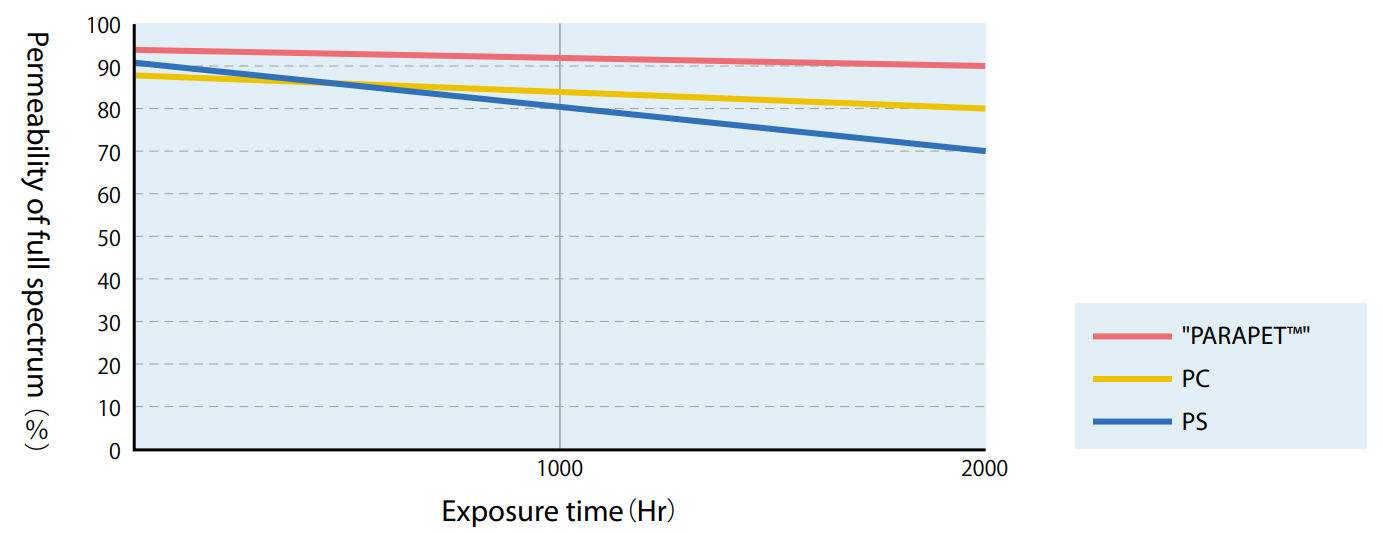
Comparison of Various Properties with Other Resins
Mold shrinkage varies depending on the shape of the molded product and the molding conditions. In other words, it depends on the resin density and orientation strain in the cavity, and is greatly affected by resin temperature, mold temperature, and injection speed in the molding conditions. A comparison of mold shrinkage between PARAPET™ and other resins is shown in the figure on the right.
In mold design, the mold shrinkage "0.2-0.6%" value measured by the JIS method is generally used.
When comparing the direction of resin flow to the direction perpendicular to the flow, shrinkage is generally 0.05-0.15% greater in the flow direction .
| Material name | Mold Shrinkage (%) |
|---|---|
| PARAPET™ (methacrylic resin) | 0.2-0.6 |
| Polycarbonate | 0.5-0.7 |
| Polystyrene (for general use) | 0.2-0.6 |
| AS Resin | 0.2-0.6 |
| ABS resin | 0.3-0.8 |
| Polypropylene | 1.0-2.5 |
| Polyethylene (H.D.) | 2.0-5.0 |
| Nylon Resin-66 | 1.0-2.5 |
Note: The property values shown are typical values and are not guaranteed.


